Jan 072013
 
2013Jan7-NoRetryOnMissingProgramFilesError

Post URL: http://social.technet.microsoft.com/Forums/en-US/configmanagerosd/thread/694ae620-f92e-4076-b8ee-368bae20d97d

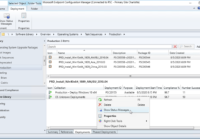
Why in god’s name doesn’t the Developers of SCCM add a retry button to this dialog. Anytime I’m missing 1 package, I have to restart the machine? Seems silly at this point..

-BG

Share
Jan 042013
 

Question Posted: http://social.technet.microsoft.com/Forums/en-US/configmgrgeneral/thread/52fea4c4-6711-4ad0-b3bb-98201fe90fff

- SOLVED (See Below)

1 2008 R2 server acting as DC, WSUS, WDS, and SCCM 2012 SP1 server. Running in a VM Workstation V9.01. VMNet 2 is assigned to both the SCCM server and Client VM. MDT 2012 has been added and Boot Images have been created and staged in DP. Boundaries created for both the IP Subnet (192.168.5.0) and AD. Clients PXE boot, but then get the “AbortPXE” packet.

2013Jan03-AbortPXEError

The server “SMSPXE.log” is showing the following:
00:0C:29:60:B8:16, 428B4D56-B0E3-A0C3-1316-1286D560B816: could not find boot image S0100009
00:0C:29:60:B8:16, 428B4D56-B0E3-A0C3-1316-1286D560B816: Not serviced.

2013Jan03-BootImageNotFound

As per the content status, the boot image is staged and raring to go..

2013Jan03-BootImageContentSettings

To fix the issue, I needed to do the following:
1. Tick the “Deploy this boot image from the PXE-enabled dis…” box from the “Data Source” tab of the Boot Image used in the Task Sequence.
2013Jan07-DeployBootImageCheckbox
2. Remove the “Distribution Point” role from “Servers and Site System Roles”.
3. Re-Add the “Distribution Point” role and re-distribute all packages.

-Brian G (http://supportishere.com)

Share
Jan 182012
 

In many Organizations, the AD support team is separated from the team in charge of Imaging.  The AD team naturally is protective with their setup and fight any GPO setting that would result in more responsibility to their staff.  So that leaves us in some occasions having to turn to Local Group Policy to apply the settings we want.  I’ve recently come across some great tools provided by Microsoft (very quietly) for Government usage.  These tools allow you to basically back up your LGPO settings to a txt file and apply them on demand with a script silently.

MS link: http://blogs.technet.com/cfs-file.ashx/__key/communityserver-components-postattachments/00-03-05-16-48/LGPO_2D00_Utilities.zip
BackUp link: https://panaconsulting.egnyte.com/h-s/20120118/077e07ba18c74413

How to use:

  1. Apply desired settings on a Windows 7 test machine, using the gpedit.msc MMC snap-in.
  2. Run the “ImportRegPol.exe” with the /parseonly and /log to pull settings and save to a specified LOG file.
    User settings and machine settings need to be captured separately:
    LGPO User Settings
    Capture User Example
    ImportRegPol.exe /u  C:\Windows\System32\GroupPolicy\User\registry.pol /parseonly /log <PathToSettingsFile>.log
    LGPO Machine Settings
    Capture Machine Settings Example:
    ImportRegPol.exe /m  C:\Windows\System32\GroupPolicy\Machine\registry.pol /parseonly /log <PathToSettingsFile>.log
  3. Use the Apply_LGPO_Delta.exe utility to apply the settings silently.  On restart the settings will take effect.
    Apply_LGPO_Delta.exe <PathToSettingsFile>.log /log <PathToLogFile>.log
  4. This can easily be added to an SCCM or MDT Task Sequence and tied to logic to ensure the correct settings get pushed to the appropriate target systems/users.

Command Line help for LGPO Tools:

Apply_LGPO_Delta.exe inputfile0 [inputfile1 ...] [/log LogFile] [/error ErrorLogFile] [/boot]

inputfileN             One or more input files specifying the changes to make.  Input files must be security template files, or registry-based policy files using a custom file format described below.  Apply_LGPO_Delta automatically determines whether a file is a custom policy file or a security template.  Security templates can be created using the “Security Templates” MMC snap-in.

/log LogFile           Writes detailed results to a log file.  If this option is not specified, output is not logged nor displayed.

/error ErrorLogFile   Writes error information to a log file.  If this option is not specified, error information is displayed in a message box dialog.

/boot                  Reboots the computer when done.


ImportRegPol.exe –m|-u path\registry.pol [/parseOnly] [/log LogFile] [/error ErrorLogFile] [/boot]

-m path\registry.pol   [for Computer configuration] or

-u path\registry.pol   [for User configuration]

Path\registry.pol specifies the absolute or relative path to the input registry policy file (which does not need to be named “registry.pol”).

/parseOnly             Reads and validates the input file but does not make changes to local group policy.  In conjunction with the /log option, can be used to convert a registry policy file to an input file for Apply_LGPO_Delta.

/log LogFile           Writes detailed results to a log file.  If this option is not specified, output is not logged nor displayed.  The logged results for the registry policy settings can be used as input for Apply_LGPO_Delta.

/error ErrorLogFile   Writes error information to a log file.  If this option is not specified, error information is displayed in a message box dialog.

/boot                  Reboots the computer when done.


-Brian G

Share
Dec 292011
 
SCCMError

Received the “SMS Collection Evaluator failed to process Collection Settings changes” error in SCCM on the “SMS_COLLECTION_EVALUATOR” Component. The fix was simple and simply overlooked during the SCCM installation:

1. Open the ADSI editor.
2. Browse to the “System Management” container. Should be listed under the “System” container.

3. Right-Click on the “System Management” container and click on the “Properties”.
4. Click on the “Security” tab and review if the “$” user exists. If exists, skip to step 6.
5. Click on Add, then “Object Types” and then check the “Computers”. Next type the Computername of the SCCM server and click on “OK”.


6. Click on “Advanced” and then highlight the “” entry and click on “Edit”.
7. Change the “Apply To” Drop Down to “This object and all descendant objects” and then check the “Allow Full control” permission.

8. Restart the SCCM server.

-Brian G

Share
Jan 102011
 

Figured I should share my two favorite applications I use frequently for repackaging setup files to .Msi files for integration into MDT or SCCM.  Best part is they are both FREE.

AdminStudio Configuration Manager Edition
Latest Version: 9.5
URL: http://www.flexerasoftware.com/promolanding/7698.htm
Developed by Flexera, approved by Microsoft and integrated into SCCM.  Highly tested and simple.  one of the largest Cons, is that the free version requires a SCCM server for usage.

Note: Registration on FlexeraSoftware.com to obtain license key.

Continue reading »

Share